Showing posts with label Springboard. Show all posts

5/24/14

2014 Sightings | May 24 Part I

Today was the best whale watch I have seen this season thus far!

Acrobatic calf breaches

We headed out towards the southwest corner of Stellwagen Bank on the Asteria and saw three humpback blows in the area.  We passed a single traveling humpback to go directly towards Tornado and her calf, who started flipper slapping, tail slashing, and rolling around at the surface.  The calf was being very playful right next to our boat and Tornado gave us wonderful close up views as they went right under our bow and fluking right next to the boat.  There were two humpbacks traveling together in a deliberate southeast direction and closely passed Tornado and her calf.  Tornado and her calf started milling and slowing down their behavior when I noticed a lot of commotion in the distance. About 4 miles north of us near mid-bank I could see at least 8 different blows with a lot of white water and numerous birds. This was a great indication of a lot of feeding activity!  We left Tornado and her calf to go investigate all the commotion.


Synchronized fluking

I was so excited to see that we found a highly productive area on Stellwagen Bank that seemed to attract 12-15 humpbacks, a couple of minke whales, and hundreds of gulls and shearwaters. We first stopped on a whale named Milkweed, born to Trident, with her calf by her side  Trident is a very popular whale on Stellwagen because she is one of our largest females in the population and had her first calf at only 5 years of age!  Milkweed and her calf came very close to our boat and were giving trumpet blows, an indication of pure excitement. The calf was rolling at the surface while Pleats came right over and started feeding next to Milkweed.

Feeding frenzy—humpbacks and seabirds both in on the action

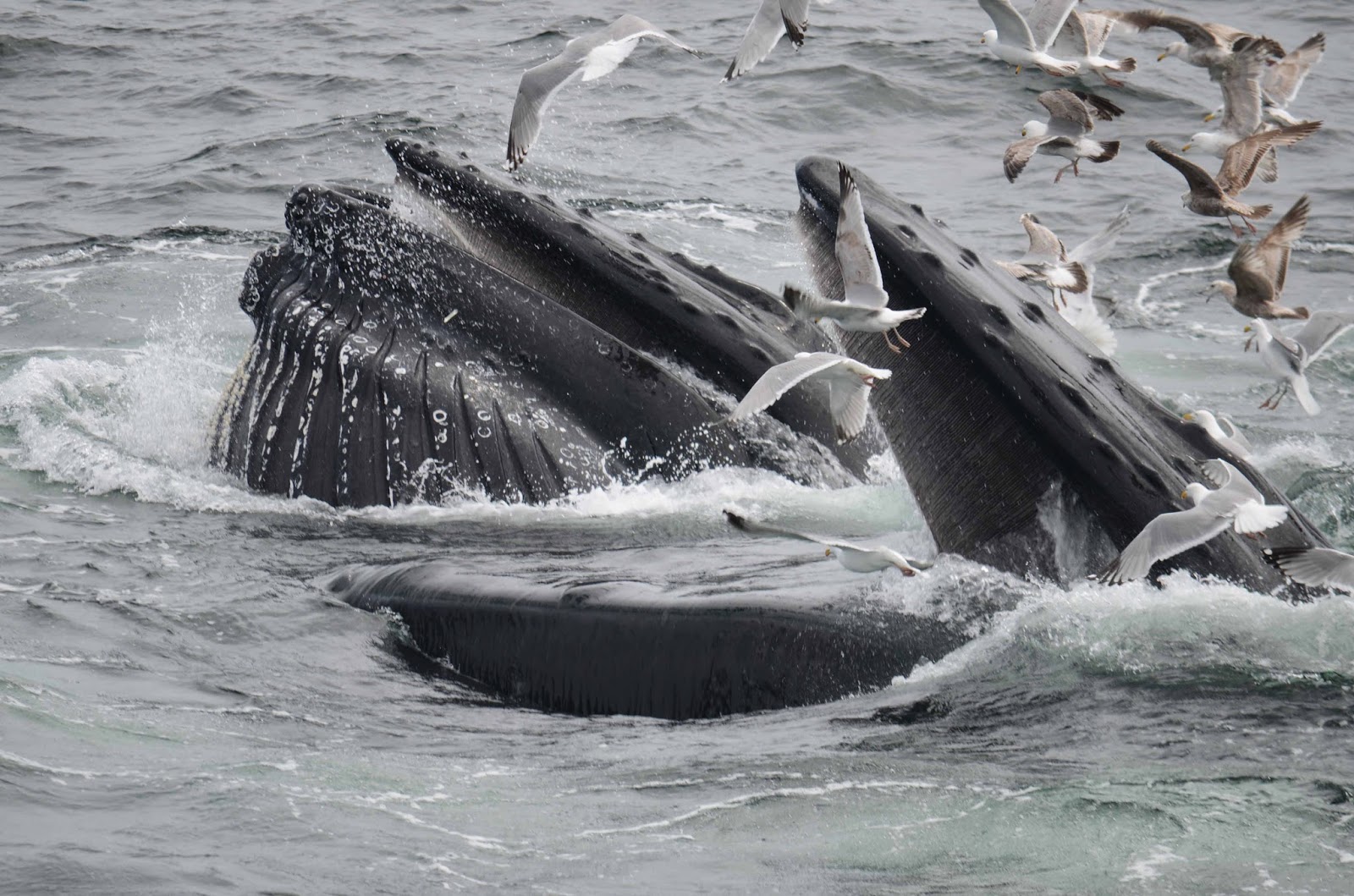
About 300 yards away there was a large group of 6 whales feeding together, along with two pairs of humpbacks, and 2-3 singles in a 2 mile radius, making it a feeding frenzy!  The main group of whales were using shared bubble nets and consisted of Cajun, Geometry, Springboard, Daffodil, Vulture, and Eraser.  Vulture’s calf stayed about 50 yards away from all the feeding commotion and decided it was a good idea to start breaching!


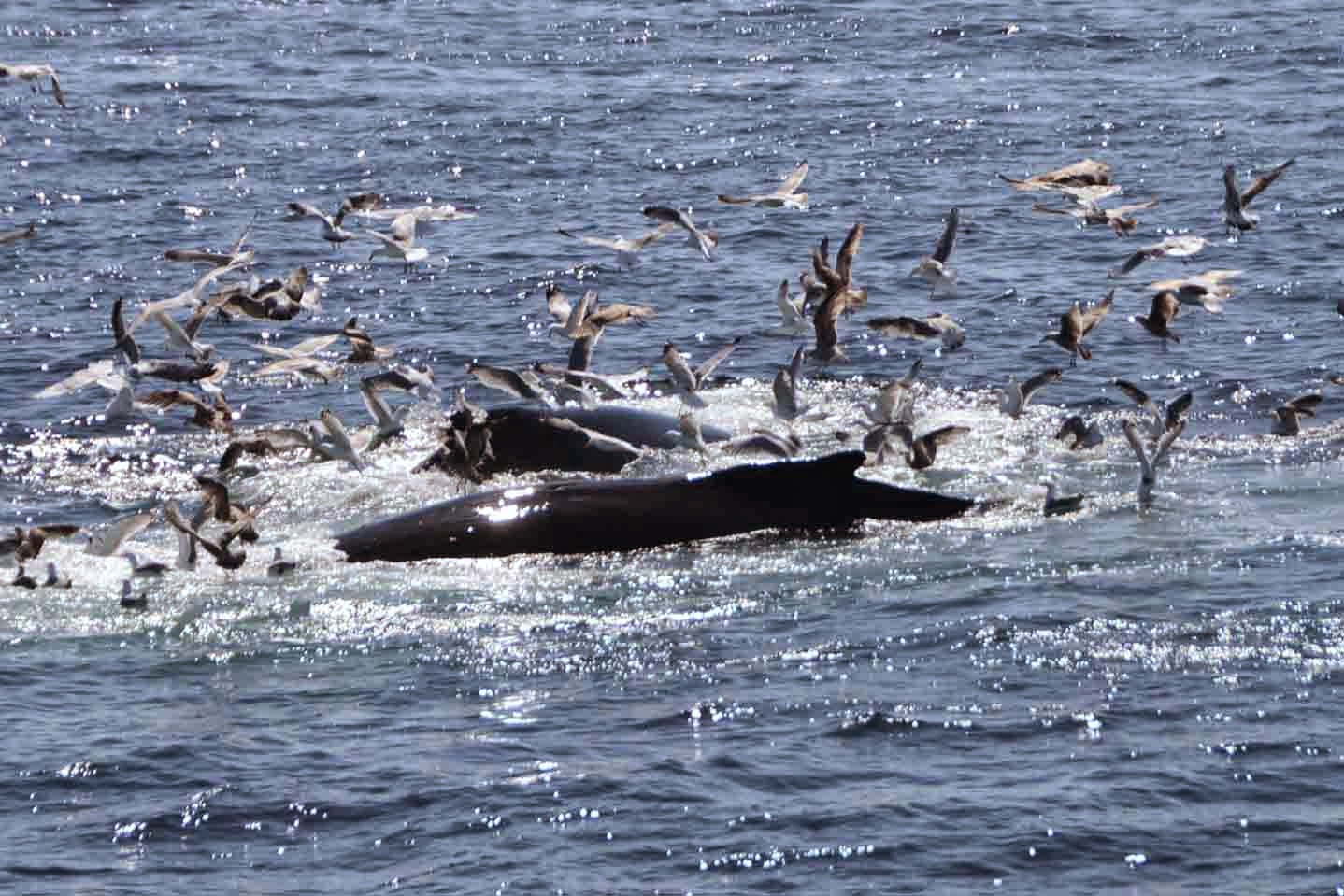
We had simultaneous aerial activity from the calf including head breaches, full spinning head breaches, tail breaches, back breaches, and chin slaps, all while our large group was feeding open mouth!  It was overwhelming to decide which direction was the best place to look! Pepper was seen kick-feeding about ¼ mile away with another humpback, as well as Orbit. There were other humpbacks feeding in the area and one conducted lob-tails in the distance.  Milkweed, her calf, and Pleats followed into the area and Milkweed joined the large group to share some bubble clouds. I also think a couple of humpbacks snuck in on a few bubble nets and quickly split, making it difficult to ID them. There were about 6-8 whales moving in and out of this feeding group at a given time. All the humpbacks were diving so quickly to continue trapping the sand lance and there were 150-200 gulls and shearwaters following them to get their share of the meal. It was definitely a successful feeding frenzy out there today!

A nice look at the ventral pleats on a hungry humpback whale

Two feeding humpbacks. On one, you have a chance to see some expanded ventral pleats on it’s lower jaw.
And with the other, you can see many of it’s baleen plates. 

In total, we saw 3 mother calf pairs, 2-3 minke whales, and 12-15 humpback whales.  The only activity we didn’t see today was sleeping, and I think everyone was OK with that!


5/14/14

2014 Sightings | May 14

This morning on the Asteria we headed to mid Bank and had an amazing whale watch. There were blows all around us and areas of animals feeding in every direction. We have been able to identify a total of nine humpback whales, including two calves, and photographed a 10th whale which unknown.
 
Mystery whale

We started out with Glo-stick and calf. The calf was doing some energetic breaches – always fun to see! This is Glo-stick’s first known calf and the fourth generation of calves to be identified on Stellwagen Bank. We also know this little calf’s grandmother, Scylla and great-grandmother, Istar.

Springboard

We moved on to Springboard and Aswan who were doing some great bubble feeding, creating huge circles of bubbles underwater and coming up open mouthed in the middle to catch fish. Springboard is a female first sighted in 1997 and Aswan is a 3rd generation male. Aswan’s mother is Nile who we saw so much of last year.

Open-mouth feeding: exhibit A

We then found another mother and calf pair which were joined by a third animal. It’s quite common to see mother-calf pairs joined by an escort. In this case the mother and escort were engaging in some bubble feeding while the calf regaled us with numerous tail breaches. It took a bit of id-ing but we figured out that this mother is a whale named Vulture. Vulture was first seen in 1988 and has had numerous calves since then. The escort is an animal named Thunderstorm, a whale first seen in 2009.

Calf doing some frisky tail breaches

Last but certainly not least we joined a group of four animal doing some very impressive bubble rings and open mouth feeding. We spotted Pleats, Cajun, Aswan again, and our unidentified whale.

It was fantastic trip with many different animals and lots of exciting behaviors.

Cheers!
Tegan

5/12/14

2014 Sightings | May 12 afternoon

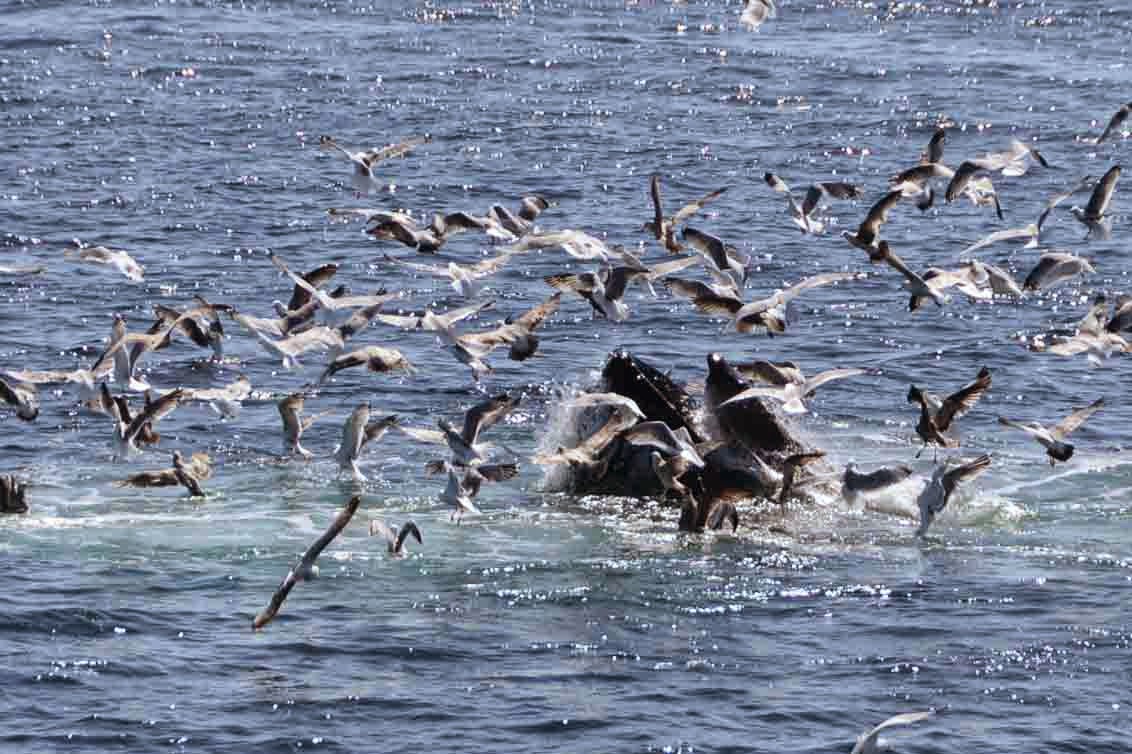
On the Cetacea, we headed back to mid-bank to find a whole bunch of activity. When we arrived, we found scattered blows of several humpbacks, including splashes from kick-feeding and tons of gulls swarming around the bubble clouds in the distance. We estimated about 10 to 12 whales around in total.

Whale feeding frenzy

Pepper and Tongs

We first spotted humpbacks Pepper and Yoo Hoo bubble feeding in the distance (Pepper lunged open-mouthed at the surface a few times), who quickly joined up a bit with Tongs and her 2014 calf to continue to feed. It was great to see so much bait around and bird activity!

Pleats fluke

After that the whales started to spread out a bit. We spent more time with Tongs and calf (the calf even rolled a bit!) and also one of our crew members spotted a full breach of humpback Pleats (Ventisca’s 2008 calf).

Springboard kick feeding

We wrapped up our trip moving to another scattered group of Springboard, Milkweed and calf, and a few other individuals. We observed even more kickfeeding, a large bubble cloud of 3 feeding humpbacks (see photo of feeding frenzy at top), and wrapped up the trip with Milkweed’s calf lobtailing. We got a great look of the calf’s milky-fluke, which will become a more permanent pattern by the time it is about 2 years old.

Milkweed calf tail lob

Another great day on Stellwagen!

— Laura Howes

5/11/14

2014 Sightings | May 11

On this morning’s whale watch, we once again headed east down the shipping lanes. Very soon after passing Boston lighthouse which marks the end of Boston Harbor, we spotted two of the fin whales we spent time with yesterday. Fjord and the other familiar fin whale had traveled some distance west of where they were yesterday. We had absolutely fantastic looks of Fjord’s beautiful markings as he logged right next to the boat.

Fjord
Fjord's dorsal fin is distinctive

The other whale was nearby traveling slowly. I could tell it was one of the same whales from yesterday not by the shape of the dorsal fin—though that does help—but rather by a signature move that it often displays. This particular whale has a habit of repeatedly lifting its tail stock up out of the water just far enough that you can see its peduncle without its fluke. The peduncle is towards the end of the tail at the very base of the fluke. While fin whales don’t typically fluke, this sort of movement is typically an indication that the whale is going to dive. We call this a sounding dive as opposed to a fluking dive. However, this whale will exhibit this behavior repeatedly without diving. It’s possible that this display is associated with a feeding strategy similar to kick feeding, though I haven’t seen or heard of this technique exhibited by other fin whales. By the end of our trips yesterday, I jokingly started calling this whale Peduncle because of these unique movements that helped me distinguish this individual from the others.

Springboard

Nearby, we spotted a humpback and we had just enough time to go over and see who it was. We ended up getting some great looks at this individual who turned out to be quite difficult to ID. It was making relatively quick dives but these were mostly sounding dives which made it difficult to get a good look at its fluke. Luckily on its farewell dive, I captured a photo of the ventral fluke even though the whale was heading towards us. After much difficulty, our NEAq interns Rich and Lindsey helped me ID the whale as Springboard, a humpback who was first seen back in 1997.

On our second trip, we again passed our “Peduncle” fin whale but also got to see a large pod of Atlantic white-sided dolphins. Many of these dolphins were breeching and traveling very close to the boat. They followed us for about 10 minutes and we even spotted a mother and calf pair, a special treat for our mothers on board for Mother’s Day!

Amulet  | Photo: Molly McEachern Smith

We knew we were in for another treat when we spotted an enormous congregation of birds in the distance. The rule of thumb out at Stellwagen Bank is that where there are birds, there are whales. Low and behold, beneath hundreds of birds, Springboard and another humpback whale named Amulet were open mouth feeding and kick feeding. These two put on an incredible show for us for about 45 minutes as they corralled small fish beneath the ocean’s surface and repeatedly lunged up out of the water to devour their prize. It was such an incredible and exciting trip!

Open mouth feeding, and lots of birds | Photo: Molly McEachern Smith

Unfortunately, I had a bit of a mishap with my memory card and none of the photos I took were saved but, luckily a professional photographer on board was kind enough to let me use some of her photos for identification purposes and for our whale log! I’d like to give a very special thank you to Molly and her son Evan! Without Molly, I would not have had the photo to ID our second humpback and, without Evan, I don’t think I would have been able to find Amulet in our large humpback catalog! Thank you so much to Molly and Evan and Happy Mother’s Day to everyone!

Photo: Molly McEachern Smith

Tasia, naturalist and finback photos
All photos of feeding whales are courtesy of Molly McEachern Smith.

5/28/13

2013 Sightings: May 28, 12pm

The Asteria had a great day on the water. The seas were calm, and there were many Northern gannets as well as several different species of gulls in the area. Passengers enjoyed seeing several species of whale—while we spent most of our time with a humpback, there was a fin whale traveling not too far off from us most of the time, and a minke whale popped up right next to our humpback, and close to the boat.

Springboard's fluke

Our humpback whale was female Springboard, who was first seen in 1997. Springboard was feeding using a low bubble cloud, lunging below the water out of sight, but surfacing regularly and fairly close to our boat.

--Orla